Donate NowEmpowerment
Strengthening the Indonesian Zakat Ecosystem: Regulations, Licensing and Policy Directions of the Director General of Islamic Guidance
Development of LAZ Licensing and Urgency of Revision of Indonesian Minister of Religion Regulation (PMA) 19: Encouraging More Transparent and Impactful Zakat Governance
Development of LAZ Licensing and Urgency of Revision of Indonesian Minister of Religion Regulation (PMA) 19: Encouraging More Transparent and Impactful Zakat Governance
Jakarta - In an official report submitted to the leadership of the Directorate General of Islamic Community Guidance at the Ministry of Religion of the Republic of Indonesia, it was stated that the implementation of the latest regulations, especially Regulation of the Indonesian Minister of Religion (PMA) 10 regarding the licensing mechanism for Zakat Management Institutions, has had a significant impact in speeding up bureaucracy and improving the quality of governance of zakat institutions in Indonesia.
Acceleration of LAZ Licensing: From Two Years to Less Than Two Months
One of the main points conveyed was the latest experience from various LAZs and the Zakat Organization Forum, which stated that the licensing process which previously could take up to two years, can now be completed in just 1-2 months.
- New, more structured and efficient mechanism - Implementation of the principle of transparency through plenary sessions prior to the issuance of the Decree - Direct involvement of BASNAS to provide recommendations and open arguments. With a plenary system that involves many parties, the licensing process becomes more accountable and can be held accountable collectively.
Reasons for Revision of Indonesian Minister of Religion Regulation (PMA) 19: Field Findings and Need for Strengthening Regulations
Despite progress, there are a number of important notes in the field which are the reasons for the need for a review and revision of the Indonesian Minister of Religion Regulation (PMA) 19, including:
- LAZ Level Mismatch with Actual Capacity
- Regency level LAZ, in terms of capacity, structure and fund collection, actually exceeds provincial level LAZ standards. - On the other hand, there is a national LAZ whose capacity and collection are equivalent to districts. This condition raises questions regarding the mechanism:
- What about "higher" institutions? but small can be lowered class? - How can small institutions that meet the requirements be promoted? - Is there a time limit for applying for a class upgrade (e.g. 6 months versus 1 year)? This situation is analogous to the accreditation mechanism in higher education, where after meeting new requirements, the study program can propose an increase in accreditation without waiting for a long period.
- Consistency of National Requirements and Standardization
The Ministry of Religion's internal team has compiled a list of evaluations related to:
- Document conformity - Governance and audit - Collection and distribution - Potential overlap between new LAZ and old LAZ - Harmonization of audits, recommendations and reporting All of this confirms that the Indonesian Minister of Religion Regulation (PMA) 19 indeed needs to be strengthened to increase legal clarity and certainty.
On this occasion it was also reported that 2025 is predicted to be the year with the most significant increase in the number of LAZ, as evidenced by:
- At least 12 institutions are in the process of issuing permits - Increasing institutional capacity - Increasing public awareness of the importance of zakat. However, the Ministry of Religion also emphasized that increasing institutional permits must not stop at increasing the number of LAZs, but must produce concrete impacts for:
- Reducing poverty rates - Realizing social welfare because there are more and more LAZs, but if poverty remains stagnant, then the existence of LAZs needs to be seriously evaluated.
Emphasis on Impact: Zakat Must Be Linked to Poverty Alleviation
Zakat regulations and Presidential Instructions regarding the acceleration of poverty reduction mandate that:
- Religious funds, including zakat, must be directed towards poverty alleviation. - This is in line with the mandate of the Zakat Management Law. Therefore, the revision of the Indonesian Minister of Religion Regulation (PMA) must ensure:
- LAZ growth = impact growth - Huge collection ?' effective distribution - LAZ strengthens not only administration, but changes in the conditions of eligible zakat recipients. New Phenomenon: Many Large Entrepreneurs Want to Establish LAZ
It was also stated that currently there are new trends:
- Many large entrepreneurs are starting to consider establishing their own LAZ, such as OC, Ustadz Mahmud (UM), and Paragon. - Paragon itself has a potential zakat of 25 billion per year, but currently it is distributed to 17 LAZs through the "Paradaya? program. The problem is:
- If all entrepreneurs set up their own LAZ, then premium zakat payers will be spread too far apart and could break up the potential for large inter-LAZ collaboration. - Regulations are needed that keep the zakat ecosystem running efficiently, in synergy and not overlapping. Closing: Hope for Strengthening the National Zakat Ecosystem
The official statement closed with a request for direction to the Minister of Religion to:
- The revised Regulation of the Indonesian Minister of Religion (PMA) not only improves licensing techniques, but also - Strengthens the impact of zakat on poverty alleviation, - Builds a healthy LAZ ecosystem, - Maintains the sustainability of premium zakat payers, and - Ensures that LAZ growth is directly proportional to the welfare of the people. Thus, revising the regulations is not just a regulatory formality, but a strategic step to ensure that zakat truly becomes an instrument of real social change in Indonesian society.
Strengthening National Zakat Regulations: Directions from the Director General of Islamic Community Guidance in Evaluating Regulations of the Indonesian Minister of Religion (PMA) 19
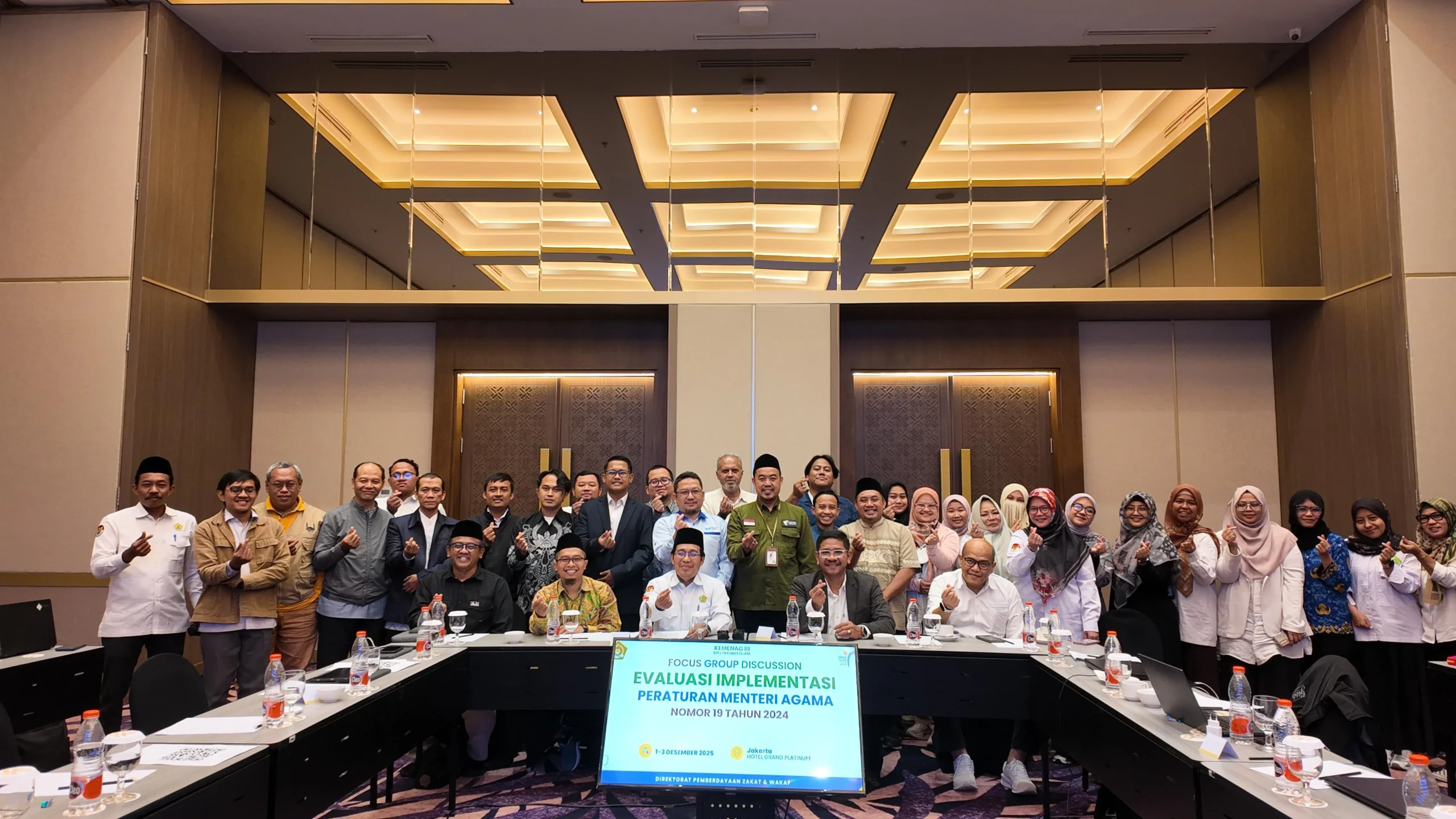
Jakarta - In an official forum attended by stakeholders from national zakat institutions, the Director General of Islamic Community Guidance at the Ministry of Religion of the Republic of Indonesia conveyed important directions regarding national zakat governance, strengthening regulations, as well as the need for an initial evaluation of Regulation of the Indonesian Minister of Religion (PMA) 19 which has been the reference for licensing and development of Zakat Management Institutions (LAZ).
This event was also attended by the Director of Zakat and Waqf Empowerment, Ministry of Religion of the Republic of Indonesia, Prof. Faryono, representatives of BAZNAS, BAZNAS Ulama, several zakat forums, axis partners, as well as all elements of Zakat Management Institutions from various levels.
Zakat: Implementation of Laws and Religious Teachings Simultaneously
In his opening, the Director General reminded that zakat management is not just an administrative or regulatory matter, but is also part of the implementation of religious teachings.
"We do not merely carry out the rules of the law, but also religious law. Because of the nature of worship, the energy and enthusiasm is definitely twice that of ordinary administrative activities," he stressed.
He gave an example that in every act of worship there are trials, and the management of zakat is certainly not free from similar challenges. Therefore, zakat management officers are reminded not to get tired of loving zakat and waqf, and to continue to maintain enthusiasm in service.
The State Provides Legitimacy: A Huge Opportunity That Must Be Safeguarded
The Director General then emphasized the importance of being grateful for the existence of the Zakat Management Law, which is the main door to the legality of Zakat Management Institutions.
- Collection of public funds can be considered illegal - LAZ cannot operate - There is no national-provincial-district structure - Distribution of zakat cannot be legally accounted for. This regulation provides a large space for the community to manage religious funds legally and responsibly.
"If there were no laws, all religious fundraising activities could be considered illegal. Thus, national, provincial and district LAZs were born. This is a door that must be cherished and guarded. ?
Indonesian Minister of Religion Regulation (PMA) 19 is still new, but it is important to evaluate it early
According to the Director General, even though the Indonesian Minister of Religion Regulation (PMA) 19 has only been in effect for one to two years, evaluation needs to be carried out early.
It is possible that there are "seeds of problems" which, if left unchecked, could develop into major problems in the future. Good regulations must prevent potential irregularities from the start.
Governance and Reporting: Keys to Building Public Trust
The Director General highlighted the importance of transparency in zakat collection and distribution reports as a form of accountability.
This report not only meets regulatory requirements, but also builds public trust and shows the benefits of zakat felt by the community.
"Whatever you collect from Muslims must be reported to Muslims as well. Public trust is expensive, and can only be maintained with transparency. ?
He compared the Zakat Management Institution (LAS/LAZ) with other sharia financial institutions such as sharia banking or sharia insurance. The difference is, if LKS seeks financial gain, LAZ aims to produce measurable social benefits for society.
Answering Ecosystem Challenges: Does Zakat Need a Market?
The Director General sparked an important discourse: Should Indonesia open up competition for zakat institutions such as large retail markets?
- If each region is filled with many LAZs, such as 24 hour minimarkets, this could cause friction - large LAZs that go down to the district level could kill space for local LAZs - Without clear league or level arrangements, there is an imbalance between large and small LAZs. The Director General questioned whether Indonesia wanted to:
- Zakat-free market model? , or - A tiered system such as a sports league, with clear criteria for going up and down levels. This is part of the evaluation that must be accommodated in the revision of the Indonesian Minister of Religion Regulation (PMA).
The Authority to Collect Funds: A Great Commission that Must Not Be Abused
The Director General emphasized that LAZ's authority is to:
- Collecting zakat - Managing social funds - Distributing people's funds? is an expensive authority that many mass organizations and other institutions even want.
Therefore, even a little misuse can cause:
- Loss of public trust - Questions about the legitimacy of the institution - Fund leaks that damage the image of national zakat "We are given great authority by the state. Don't let us end up being questioned because of our own behavior. ?
Friction is a Sign of Life: The Government and LAZ Must Synergize
In the final part of his speech, the Director General gave an interesting analogy:
- Cars move because of the friction between tires and asphalt - Likewise the dynamics between LAZ, BAZNAS, and the government - friction is a sign that the ecosystem is alive and continues to move. The Director General encourages criticism, input and dynamics not to be considered as conflict, but as material for mutual improvement.
Two Wings of National Zakat: BAZNAS and LAZ
The Director General closed his directive by emphasizing that:
- BAZNAS and LAZ are two wings in national zakat management - Both must be strong and healthy - If only one is strong, then progress will not be far and will not be high. Our big goals are the same, namely:
- Increasing zakat collection - Strengthening utilization - Prospering the people - Proving the truth of religious teachings through the benefits of zakat The Director General hopes that the discussion and evaluation of Indonesian Minister of Religion Regulation (PMA) 19 can produce the best input for strengthening regulations and improving the quality of zakat management in Indonesia.